



A Grade 9 student sits down with Rahul Subramaniam, Athena’s co-founder, and says: “I want to get into Harvard four years from now. Give me a checklist. Tell me everything I have to do.” Rahul has heard it more times than he can count. His answer never changes: “That’s the wrong approach.”
The checklist isn’t wrong. It’s just the same checklist the other 55,104 applicants were working from. Harvard isn’t looking for the student who did everything. It’s looking for the student who could only be them. So what does Harvard look for in a student? Here’s the answer in practice, from Part 1 of our series Making of a Harvard Admit.
The short version
- In Harvard’s words: it is “much more interested in the quality of students’ activities than their quantity.”
- Why copying fails: the officer reading your child’s file may already have read the playbook, in a cousin’s application.
- What works instead: an unfair advantage, the overlap of your child’s talent, passion and resources.
- The surprise: passion often follows talent. If one of the three is strong, the others can be built.
- The rule of thumb: one thing for years beats ten things for a year.
Watch: Making of a Harvard Admit, Part 1. The checklist question comes up at 3:07.
What does Harvard look for in a student, in its own words?
Harvard doesn’t publish a formula. It does leave clues, and they all point the same way.
- Quality over quantity. Harvard’s application tips say it is “much more interested in the quality of students’ activities than their quantity”. The details students give “help us to understand the depth of your involvement”.
- What shaped you. The five required short answers in the 2026–27 supplement ask how a student’s “life experiences and academic and extracurricular activities shaped you”, and how they hope to use a Harvard education. Each answer is capped at 150 words.
- Your own voice. The same supplement says Harvard “expects that applicants will express themselves authentically in all aspects of their applications.”
Grades, test scores and teacher letters still have to be there. For Indian applicants, the full list is in our guide to Harvard admission requirements for Indian students. But requirements decide who gets read. Depth decides who gets in.
Why your cousin’s playbook doesn’t work
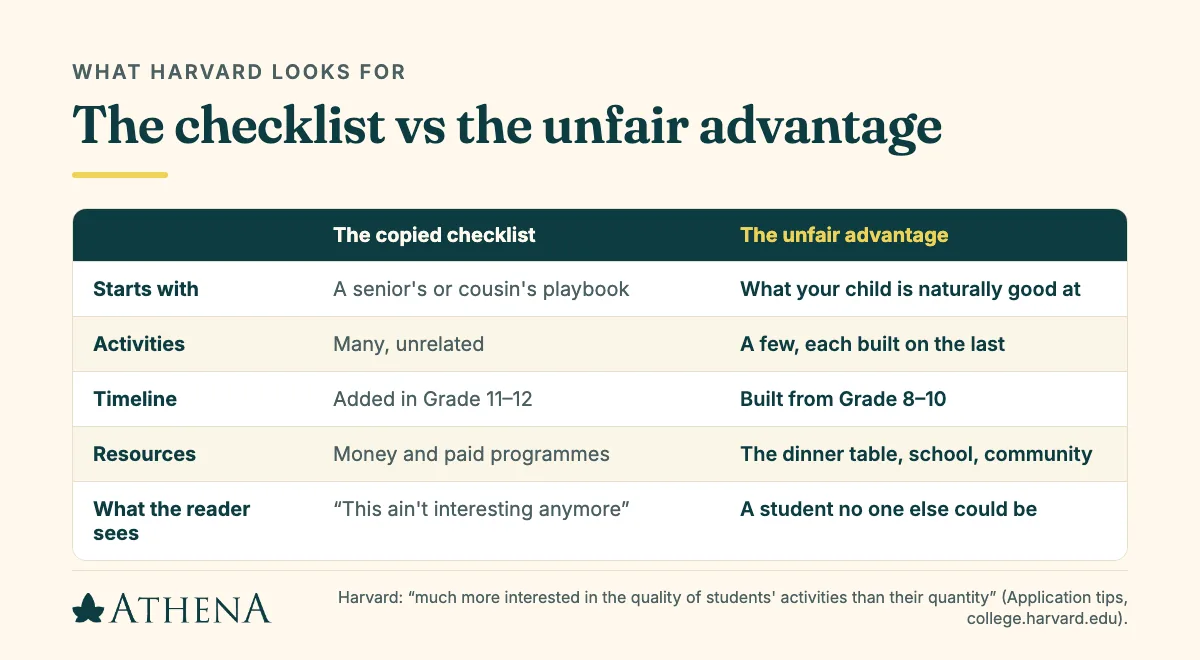
Every Indian family knows the move. A senior from school, or a cousin who got into Cornell, did A, B and C. So the plan becomes A, B and C.
Rahul explains why it backfires: “The admissions officers who might be the same person who read your high school senior’s or cousin’s application will look at the same activities and be like, this ain’t interesting anymore.”
A copied playbook can’t be authentic, and authenticity is where Rahul starts with every student. It begins with three questions: what are my talents, what are my passions, and what are my aspirations?
Quick rule: if you can name the student whose application your child’s is modelled on, so can the admissions office.
What is an unfair advantage?
Rahul’s name for what Harvard is really reading for is an unfair advantage: the thing a student can bring that almost no one else, anywhere, can. It sits where three things overlap.
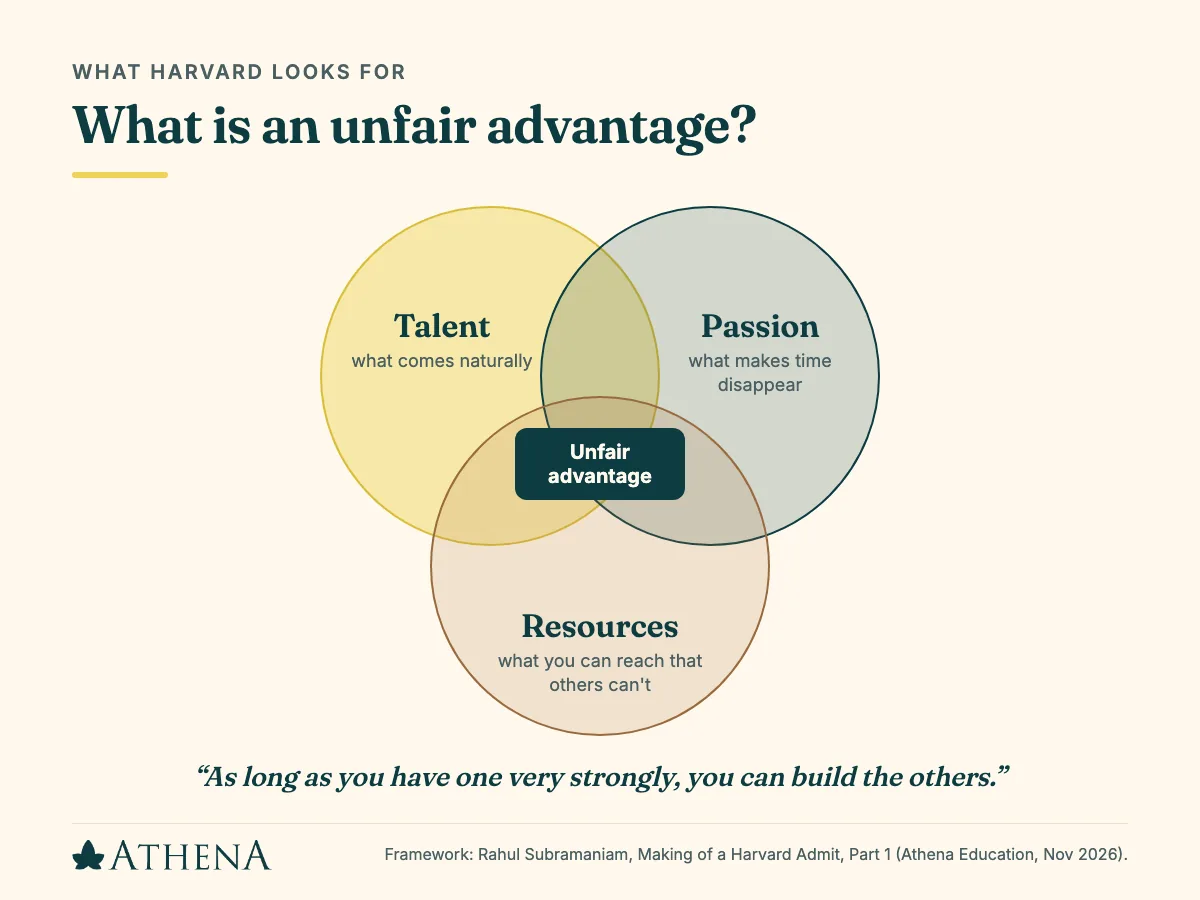
- Talent is what comes naturally. It needn’t show up on a report card. “There’s so many great designers, fashion designers, product designers who may not have been that good in school, but they were always doodling on the margins.”
- Passion is what your child loves doing, even when nobody asks. What do they lose track of time doing?
- Resources are what your child can reach that others can’t. Rahul’s example is Bill Gates, whose school got a computer terminal in 1968, when hardly any teenagers could use one.
Resources is the part parents most often misread, because it sounds like money. It usually isn’t. It’s what’s available at the dinner table. Rahul’s example: “Let’s say mommy or daddy is a corporate lawyer. I’m not saying you have to be a corporate lawyer, but they’re probably really good at negotiation. Can you learn negotiation and apply it to diplomacy?” A parent’s career, a grandparent’s craft, a school’s lab, a family’s languages: all of these count.
Passion often follows talent
“Follow your passion” is the advice every teenager gets. Rahul thinks it’s often the wrong way round. “Here’s the secret: passion sometimes follows talent.”
He uses his own story. When he started mentoring, he wasn’t especially passionate about it. He got good at it, people valued it, and the passion grew with the skill. Music works the same way. The first months of piano are scales, and scales are dull. But once a child can play well enough to perform carols at a family gathering, the passion rises. “These aren’t variables in isolation.”
That’s good news for parents of a child with no obvious passion at 13. You don’t have to wait for one to arrive. Find what comes easily, let your child get good at it, and watch what happens. “As long as you have one very strongly, you can build the others.”
Depth beats the buffet
The most common trap Rahul sees isn’t laziness. It’s what he calls the paradox of choice: “They sample everything in the buffet as opposed to just picking one and saying, okay, I’m going to get amazing at this.”
His example is one every Indian mother will recognise: Dolly Jain, the celebrity saree draper. Picture her at 15 telling her mother she wants to drape sarees, and the reply: become a doctor, be respectable. She focused on one thing and got so good at it that she’s now a household name.
Harvard isn’t asking your child to become a household name. It is asking for the same pattern: a talent and a passion “developed systematically over years”. That’s why Rahul’s question for every student is “What can you do at a world class level?” Not world champion. World class.
What this means for students from India
Three things change for Indian applicants.
- The track is set early. Subjects by Grade 10, a stream by Grade 11. An unfair advantage often sits across streams, so the search has to start before the stream decides it.
- “Lucrative on paper” can wait. A Grade 9 student’s unfair advantage may not sound like a career yet. That’s fine at 14, as long as the family revisits the practical question later. We cover that, including what to do when it’s art, in our 3-month plan for finding your child’s passion.
- Depth will matter more after admission too. Rahul’s view on AI: tools trained on the average of everything can take work to 80–90% of the way. “If you’re in the top 10%, then you can critique that output and make it better.” The depth Harvard reads for is the same depth that stays valuable.
Our take
Most advice on what Harvard looks for is a list: grades, scores, leadership, service, a “spike”. The list is accurate and almost useless, because every serious applicant has read it. What separates admits is how the list came about. A Harvard file reads strongest when each activity grew out of the one before, from a curiosity the student actually had.
So the useful question for an Indian family isn’t “what does Harvard want?” It’s “what is our child unusually good at, and how do we give them years to build on it?” That’s harder to answer, and it’s the only version of the question that can’t be copied.
Harvard can tell the difference between an application that was assembled and one that was built. If you’d like help working out what your child’s unfair advantage could be, book a session with an Athena mentor. No obligation, just an honest read.
Also in this series: How to get into Harvard from India · My child has no passion: a 3-month plan
FAQ
What does Harvard look for in a student?
Harvard publishes no formula, but it says it is much more interested in the quality of a student’s activities than their quantity, and it asks applicants how their experiences and activities shaped them. In practice, that means depth: an interest built over years.
What does Harvard look for in international students?
The same things it looks for in every applicant, read in the context of the student’s school and country. International students made up 15.4% of the Class of 2030, from 86 countries, and Harvard says foreign students have the same access to financial aid as US citizens.
How many extracurricular activities do you need for Harvard?
There’s no required number. Harvard says it cares more about the quality of activities than how many there are. A few activities that build on each other usually say more than a long list of unrelated ones.
Does Harvard prefer well-rounded students?
Harvard doesn’t publish a preference. In our experience, an applicant with solid all-round academics and one area of real depth reads more strongly than one who is equally involved in everything.
Do you have to be a genius to get into Harvard?
No. The admits Rahul has mentored usually started with an ordinary curiosity and built on it for years. In his words, everyone has an unfair advantage to find; the work is finding it early enough to build on it.
Sources (all checked 12 November 2026)
- Harvard College, application tips: quality versus quantity of activities.
- Harvard College, first-year supplement 2026–27 (PDF): the five short-answer questions and the authenticity statement.
- Harvard College, financial aid fact sheet.
- The Harvard Crimson, Class of 2030 admissions data, 27 October 2026.
- Lakeside School, A history of CS at Lakeside.
- Quotes from Rahul Subramaniam are from Making of a Harvard Admit, Part 1 (Athena Education, November 2026).