



There is no Harvard entrance exam. No JEE, no NEET, no cut-off. For Indian parents raised on rank lists, that sounds like good news, until you see the other number. 55,104 students applied to Harvard for the Class of 2030, and by The Crimson’s estimate about 3.7% got in.
Almost all of them had the grades, and most had the scores. The checklist is the easy part. So if you’re working out how to get into Harvard from India, the real answer is something a checklist can’t produce: years of building on the one thing they could become unusually good at. In Part 1 of our new series, Making of a Harvard Admit, Athena co-founder Rahul Subramaniam calls that an unfair advantage. This guide covers what it is, how to find it and when to start.
The short version
- Is it possible? Yes. International students were 15.4% of Harvard’s Class of 2030, from 86 countries. Harvard doesn’t publish a figure for India.
- What’s required: the Common App, Harvard’s supplement, the SAT or ACT, a school report and two teacher evaluations. There’s no entrance exam.
- What decides it: depth. Harvard says it is “much more interested in the quality of students’ activities than their quantity.”
- When to start: Grade 8–10 is ideal, because depth takes years. Grade 11–12 isn’t too late, but the job changes from adding to sharpening.
- First step: find where what your child is good at, what they love and what your family can give them access to overlap.
Watch: Making of a Harvard Admit, Part 1, with Rahul Subramaniam and host Anantya.
Can an Indian student get into Harvard?
Yes, and every year some do. Harvard’s Class of 2030 is 15.4% international, drawn from 86 countries. Harvard doesn’t release a country-by-country breakdown, so any “acceptance rate for Indian students” you see online is a guess. Treat it as one.
Two facts matter more to Indian families than any rate:
- Money is less of a barrier than most families assume. Harvard says foreign students have the same access to financial aid as US citizens. Families earning under $100,000 a year are not expected to contribute, and under $200,000 aid covers at least full tuition.
- Your child is read as an individual. In our experience, admissions officers judge an application against the opportunities the student actually had: their school, their curriculum, their city. A CBSE student isn’t expected to look like a student from a US prep school.
What Harvard requires from Indian applicants
The fixed part fits in one table. For the detail, including when board results can stand in for the SAT, see our guide to Harvard admission requirements for Indian students.
| What | Detail | Source |
|---|---|---|
| Application | Common App, plus Harvard’s supplement: five short answers of up to 150 words each | Harvard supplement 2026–27 |
| Tests | SAT or ACT required. Board, IB or A-Level results count instead only in exceptional cases, when a test is genuinely out of reach | Harvard testing FAQ |
| School documents | Secondary School Report with a counsellor letter, two teacher evaluations from different subjects, a midyear report | Harvard application requirements |
| Deadlines | Restrictive Early Action: 1 November. Regular Decision: 1 January | Harvard first-year applicants |
| Entrance exam | None |
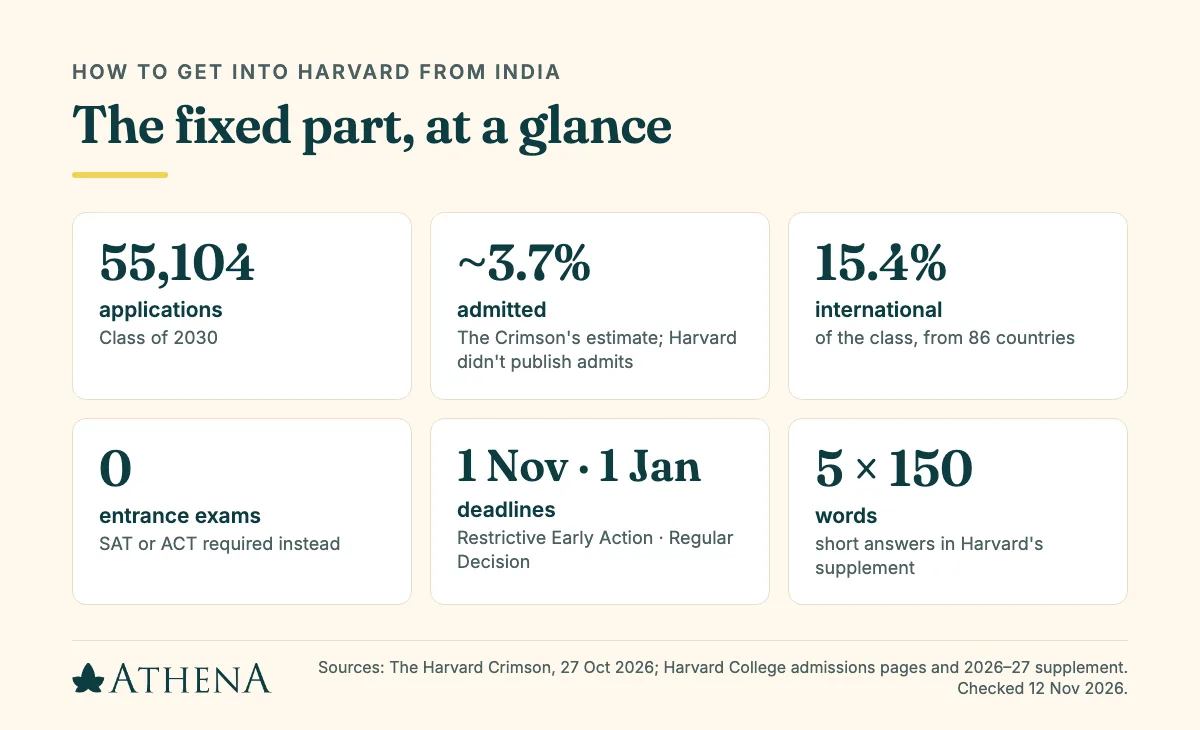
Everything in that table is necessary. None of it is enough on its own. 55,104 applicants cleared it.
Why copying a checklist won’t get your child into Harvard
The request Rahul hears most often from a Grade 9 student goes like this: I want to get into Harvard four years from now. Give me a checklist. “That’s the wrong approach,” he says.
The trouble is reverse-engineering. A family sees that a senior at school, or a cousin who got into Cornell, did A, B and C, and copies the playbook. But the admissions officer reading your child’s file may be the same person who read the cousin’s. “They’ll look at the same activities and be like, this ain’t interesting anymore.”
Harvard says much the same in its own words. It is “much more interested in the quality of students’ activities than their quantity”, and the activity details exist to show “the depth of your involvement”. A list copied from someone else is all quantity.
Quick rule: if your child’s activity list could be swapped with a classmate’s and nobody would notice, it isn’t telling Harvard anything.
Phase 1: find your child’s unfair advantage
Making of a Harvard Admit follows a Harvard application through three phases. Phase 1 starts inside the student, not on a university website.
Rahul’s question for every student is this: “What can I bring to the table that almost no other high school student in India, in the US, in Great Britain, Dubai, Singapore, or even the world can bring? What is my unfair advantage?”
He defines it as the overlap of three things:
- Talent: what comes naturally. It doesn’t have to be academic. The child who’s always doodling in the margins may be telling you something about design.
- Passion: what they love doing. What do they lose track of time doing?
- Resources: what they can get access to that others can’t. That’s not only money.
Rahul’s example for resources is Bill Gates. In 1968, the Mothers’ Club at his Seattle school bought a computer terminal, at a time when very few teenagers anywhere could use one. Talent and passion mattered. Access let him move faster than everyone else.
The nuance that matters for parents: “As long as you have one very strongly, you can build the others.” Passion, in particular, often follows talent. We go deeper on this in what Harvard looks for in a student.
How a Harvard maths application gets built, brick by brick
In each of the last two application cycles, a student Rahul mentored was admitted to Harvard for mathematics. Neither started with a “Harvard activity”. Each started with a curiosity.
In one case (we’ve kept the details general to protect the family’s privacy), it was spotting patterns as a child. In middle school came maths Olympiads. Then a programme where he learnt proofs for the first time. “Olympiads are about solving problems,” Rahul explains. “Proofs are about understanding why something is true. And that’s the basis for higher-level mathematics.” Applied work followed, then a product of his own, then research at university level.
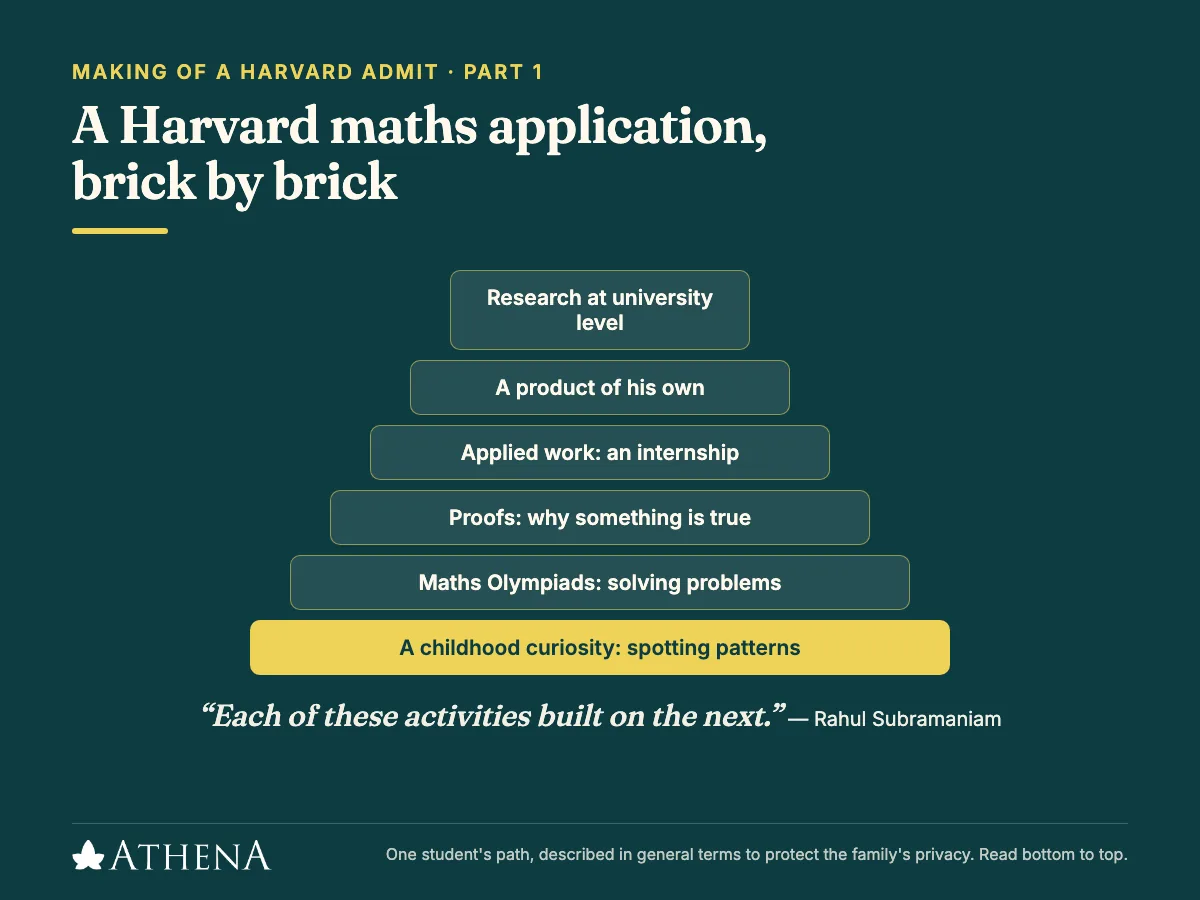
“Each of these activities built on the next,” Rahul says. “It’s very much like building a pyramid.” The achievements at the top of a Harvard application look impossible for an 18-year-old. They are impossible if you try to build the top first.
How to get into Harvard from India: when to start
Parents often ask Rahul whether there’s still enough time. His reply: “That’s like asking, is this enough time to get a gold medal at the Olympics? You’re never done.” Starting earlier means a wider base, and a wider base holds a taller pyramid.
There are two reasons the clock matters more for Indian families:
- The track gets set early. Students choose subjects by Grade 10 and a stream by Grade 11, often before they’ve worked out what they’re unusually good at. Looking for an unfair advantage means looking past the stream, not just inside it.
- The runway is longest at 14. At 24, Rahul points out, you’re exploring on weekends because you have to support yourself. At 14, you have roughly ten years before that pressure arrives. “If you invest a couple of hours every day for a decade, you’re going to be a monster. At anything.”
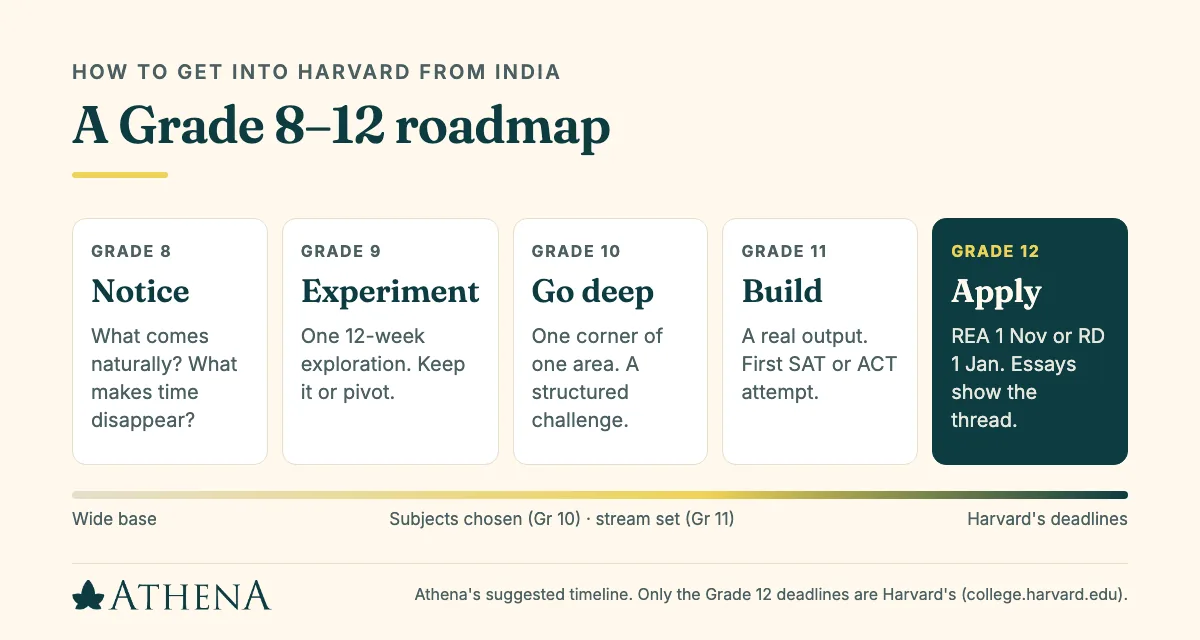
The roadmap above is our suggested timeline, not Harvard’s. Harvard sets only the last stretch: the SAT or ACT in time, then 1 November for Restrictive Early Action or 1 January for Regular Decision in Grade 12. We suggest a first SAT or ACT attempt in Grade 11, so there’s time to retake. If your child is weighing the early round, read our explainer on ED, EA, REA and RD.
What if my child is already in Grade 11 or 12?
Then the job changes. It isn’t too late to apply, but it is too late to build a new pyramid from the ground up. The work now is to sharpen what’s already there:
- Find the thread that runs through the activities your child genuinely cared about.
- Take the strongest one a level further this year: a real output, a harder competition, a mentor outside school.
- Make sure the essays and teacher letters show that thread, not a list.
Adding three new clubs in Grade 12 is quantity. Harvard has told us what it thinks of quantity.
Our take
Most advice on how to get into Harvard from India starts with Harvard. The families who do it well start somewhere else. They start with their child. A Grade 9 student who spends 12 weeks seriously exploring one interest learns more about their Harvard chances than one who memorises an admit’s résumé. If the interest holds, it becomes the base of the pyramid. If it doesn’t, they’ve spent three months and found a clue.
We’d also push back on the idea that this is only for children with an obvious gift. Rahul’s view, and ours, is that every child has an unfair advantage to find. Most just haven’t been asked the right questions yet. Our 3-month plan for finding it is where we’d start.
Harvard admits the student who built something for years, not the one who collected things for months. If you’d like a second pair of eyes on where your child’s pyramid could start, book a session with an Athena mentor. No obligation, just an honest read.
Also in this series: What does Harvard look for in a student? · My child has no passion: a 3-month plan
FAQ
Can an Indian student get into Harvard?
Yes. International students made up 15.4% of Harvard’s Class of 2030, from 86 countries. Harvard doesn’t publish how many of them came from India.
Is there an entrance exam for Harvard in India?
No. Harvard has no entrance exam of its own. It requires the SAT or ACT, and accepts board, IB or A-Level results instead only in exceptional cases, when a test is genuinely out of reach.
What is Harvard’s acceptance rate for Indian students?
Harvard doesn’t publish one, because it doesn’t release country breakdowns. For the Class of 2030 it received 55,104 applications, and The Crimson estimates that about 3.7% of applicants were admitted overall.
When should my child start preparing for Harvard?
Ideally in Grade 8–10, because the depth Harvard looks for takes years to build. Students in Grade 11–12 can still apply; their focus should shift from adding activities to deepening the one or two they care about most.
Does Harvard give financial aid to Indian students?
Yes. Harvard says foreign students have the same access to financial aid as US citizens. Families earning under $100,000 a year are not expected to contribute, and under $200,000 aid covers at least full tuition.
How do I get into Harvard after Grade 10?
Grade 10 is a good time to begin. Pick one area your child is drawn to, explore it seriously for three months, then go deeper each year. Take the SAT or ACT in Grade 11, and apply in Grade 12 by 1 November (early) or 1 January (regular).
Sources (all checked 12 November 2026)
- The Harvard Crimson, Class of 2030 admissions data, 27 October 2026: applications, estimated admit rate, international share.
- Harvard College, application requirements, first-year applicants and deadlines, testing FAQ, application tips, financial aid fact sheet.
- Harvard College, first-year supplement 2026–27 (PDF).
- Lakeside School, A history of CS at Lakeside.
- Quotes from Rahul Subramaniam are from Making of a Harvard Admit, Part 1 (Athena Education, November 2026).