


Some of the best student projects do not begin with a big startup idea. They begin with a problem most people have simply learnt to ignore.
For Daksh Pruthi, that problem was sanitation.
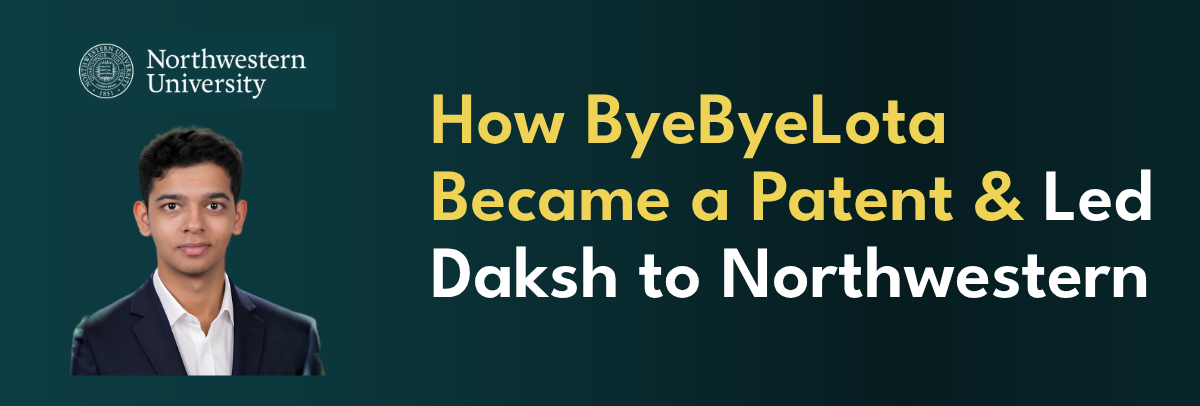
He created ByeByeLota, a low-cost portable bidet designed to turn an ordinary plastic bottle into a more hygienic washing tool. What began as a simple idea eventually became a patent-pending innovation with thousands of units distributed.
ByeByeLota also appears in Athena Education’s Class of 2026 Annual Results Report, where it is highlighted for turning a simple sanitation problem into a student-led innovation with real-world relevance.
What makes the story interesting is not just the patent process. It is how Daksh spotted an everyday problem and actually built something to address it.
How ByeByeLota Started With a Simple Problem
Students often assume that a strong passion project needs AI, robotics or complicated technology.
ByeByeLota is a useful reminder that it does not.
The product is simple. It converts a plastic bottle into a portable faucet that can offer a more hygienic alternative where proper sanitation infrastructure is limited.
External coverage reports that the device can be produced for under ₹10, making affordability central to the idea. It also gives single-use plastic bottles another purpose, adding a sustainability angle to the project.
That combination matters.
Daksh was not trying to invent the most technically complex product possible. He was trying to solve a real problem in a way people could actually use.
It is similar to the principle behind turning a hobby into a college admissions asset: the strongest projects usually grow when a student moves from interest to action.
How ByeByeLota Became Patent-Pending
Creating a prototype is one step.
Proving that people actually need it is another.
Athena’s Annual Report lists ByeByeLota as patent-pending, showing that Daksh moved beyond the initial concept and began protecting the innovation formally.
More importantly, the product made it into the real world.
So far, ByeByeLota has distributed 3,500+ faucets through 20+ workshops, impacting more than 30,000 lives, with an ambitious goal of reaching 500,000 families.
That is where a school project starts to look very different from a résumé activity.
For students building something of their own, the progression is worth noticing:
- Identify a problem people genuinely face
- Build a practical solution
- Test it with real users
- Improve it based on what you learn
- Seek patents, funding or recognition once the work has substance
The patent process matters because there is real work behind it.
If you have an idea but are unsure how to turn it into a meaningful project, you can book a free consultation to explore what could make sense for your interests and college profile.
Why ByeByeLota Strengthened Daksh’s College Profile
A patent-pending product looks impressive on paper.
But that alone is not what makes ByeByeLota compelling.
The project shows several things about Daksh at once: problem-solving, engineering thinking, social awareness and the ability to take an idea beyond the classroom.
That creates a much stronger story than simply writing “Founder” on an activities list.
Athena’s guide to what admissions officers actually read first explains why coherence matters. Strong applications make it easier for a reader to understand what a student genuinely cares about.
Selective universities increasingly look for authenticity, ownership and evidence behind student activities rather than simply the number of things on a résumé.
ByeByeLota has those markers.
There is a clearly defined problem. There is a product. There are real users. There is measurable impact. And there is independent coverage validating the work.
What Students Can Learn From ByeByeLota
The biggest takeaway from ByeByeLota is not that every student needs to invent something or file a patent.
It is that good project ideas are often closer than you think.
Maybe there is something frustrating about your school, neighbourhood or daily routine.
Maybe an existing solution is too expensive.
Maybe a problem everyone accepts as “normal” could actually be improved.
That is often where a genuine project starts.
Daksh took an everyday sanitation problem and turned it into a low-cost product that people could actually use. The project then grew through distribution, awareness work and the patent process.
That progression is more meaningful than chasing an impressive title from day one.
Students starting earlier also have a natural advantage because they have time to test and improve their ideas. Athena’s guide on building a college profile from Grade 10 explains why sustained work usually creates a stronger profile than collecting activities close to application season.
ByeByeLota did not become interesting because someone labelled it a “passion project.”
It became interesting because Daksh built something real and put it in the hands of real people.
You can explore ByeByeLota and other standout student projects in Athena’s Class of 2026 Annual Results Report.
And if you’re trying to figure out what kind of project could genuinely fit your own interests, book a free consultation and join the Discord community to exchange ideas, discover opportunities and witness what other students are building.