


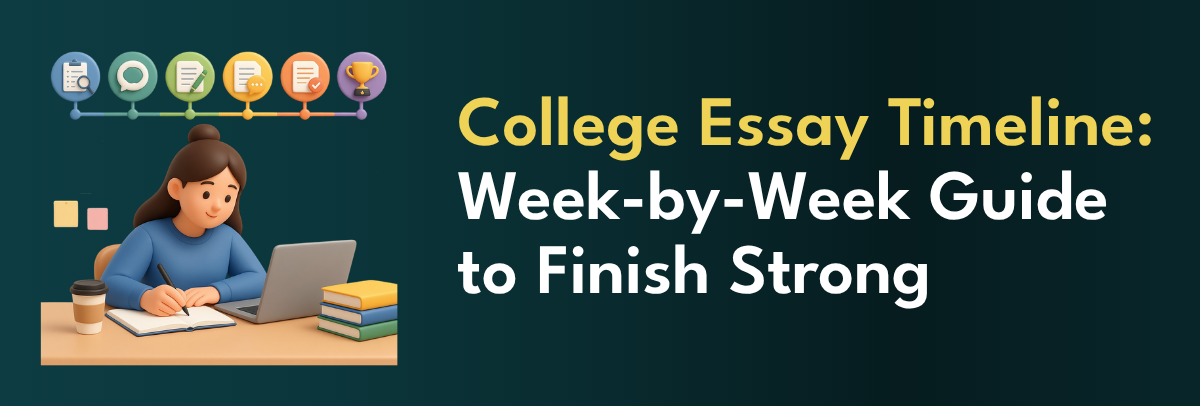
A college essay timeline can save you from the kind of panic that begins with a blank document and ends with a rushed submission at 11:57 p.m. The strongest essays rarely appear in one inspired sitting. They grow through observation, imperfect drafts, thoughtful feedback and several rounds of revision.
Yet many students delay writing because they believe they need a brilliant topic before they can begin. Others spend weeks searching for the “perfect” opening line. Meanwhile, schoolwork, tests, activities and application forms continue to compete for their attention.
The solution is not to wait for inspiration. It is to divide the process into manageable stages.
This eight-week plan gives you enough time to explore your experiences, draft properly and revise without losing your natural voice. You can shorten or extend it depending on your deadlines. However, the order matters: discover the story first, shape it next and polish it last.
College Essay Timeline: Weeks 1 and 2 for Discovery
Week 1: Build a story bank
Do not begin by trying to write a 650-word Common App essay. Begin by collecting material.
Create a document and list moments from your life that still feel vivid. These do not need to be your greatest achievements. In fact, ordinary experiences often contain more personality than award ceremonies or competition results.
Think about a conversation that changed your mind, a responsibility you quietly took on, a mistake that embarrassed you or a habit that says something unexpected about you. You might also recall a family ritual, an unusual interest, a difficult transition or a question you keep returning to.
At this stage, write quickly. Do not judge whether each idea is “good enough for college.”
Try to collect at least 10 possible moments. For each one, note what happened, why it mattered and what changed afterwards. This prevents you from choosing a topic based only on prestige.
Week 2: Identify the deeper meaning
Now return to your story bank and look for ideas that reveal something important about how you think.
Ask yourself:
- What did I believe before this experience?
- What did I understand afterwards?
- What tension or contradiction does the story contain?
- Which part of my personality becomes visible?
- Could another student write the same essay?
“Winning a competition taught me perseverance” could belong to thousands of applicants. However, the exact way you prepared, reacted, failed, adapted, or reconsidered your priorities may be unique to only you.
Choose two or three promising topics rather than committing immediately to one. Then write a short paragraph about the central insight behind each story.
By the end of Week 2, you should know what each possible essay would reveal and not merely what happened.
College Essay Timeline: Weeks 3 and 4 for Drafting
Week 3: Test your strongest ideas
Write a rough opening and one key scene for each of your top two topics. This is not wasted effort. Sometimes an idea sounds meaningful in your head but becomes flat on the page. Another idea may initially appear ordinary, yet come alive through detail.
Notice which draft gives you more room to explore.
A useful essay usually contains movement. There is a gap between what you thought at the beginning and what you understand by the end. That change may be emotional, intellectual or behavioural.
Once you select the stronger topic, create a simple structure:
- Open near a moment of tension, curiosity or change.
- Give the reader enough context to understand the stakes.
- Develop one or two specific scenes.
- Reflect on what the experience exposed or changed.
- End by showing how the insight continues to shape you.
Keep the structure flexible. Its purpose is to prevent the draft from turning into a chronological report of everything that happened.
Week 4: Write the complete first draft
Your first full draft should be honest, not elegant.
Set aside the pressure to sound impressive. Instead, write as though you are explaining the story to one intelligent person who genuinely wants to understand you.
Do not stop every few sentences to perfect the grammar. Constant editing can interrupt the emotional logic of the story. Finish the draft first, even if it is too long or inconsistent.
Aim for specificity. Replace “I became more confident” with the moment you finally raised your hand, challenged an assumption or spoke despite knowing your voice might shake.
Similarly, avoid summarising months of experience when one scene could make the point more effectively.
At the end of Week 4, you should have a complete draft. It does not need to be ready for submission. It only needs to contain the real story.
College Essay Timeline: Weeks 5 and 6 for Revision
Leave the essay alone for a day or two before revising it. Distance helps you see what the draft actually says rather than what you intended it to say.
First, examine the larger questions.
Is the essay about you, or does another person dominate the story? Does the opening lead naturally into the central idea? Have you spent too many words explaining context? Does the reflection feel earned?
Cut any paragraph that exists only to prove that you are accomplished. Your application already contains grades, honours and activities. The personal essay should reveal something those sections can’t.
Next, check the balance between action and reflection. A story with no reflection may feel entertaining but shallow. On the other hand, an essay made entirely of lessons can sound abstract. The reader needs both experience and interpretation.
A strong revision may require repositioning paragraphs, deleting an opening or rewriting the ending completely. That is normal. Revision is not the final clean-up stage. It is where the essay discovers its shape.
Week 6: Seek focused feedback
Choose one or two trusted readers. Too many opinions can pull the essay in conflicting directions until it no longer sounds like you.
Instead of asking, “Is this good?” ask specific questions:
- What do you understand about me after reading this?
- Where did your attention begin to fade?
- Which section felt unclear or rushed?
- Did any sentence sound unlike the way I normally think or speak?
- What part stayed with you afterwards?
Feedback should help you see the reader’s experience. However, it should not turn the essay into something written by an adult.
Be cautious when someone replaces your vocabulary, rewrites entire paragraphs or adds polished conclusions you would never naturally express. A college essay does not need to sound like a professional opinion column. It needs to sound like a thoughtful student with something real to say.
College Essay Timeline: Weeks 7 and 8 to Finish Strong
Week 7: Refine the language
Once the story and structure are working, edit at the sentence level.
Remove repeated ideas, unnecessary adjectives and generic phrases. Look for sentences that explain what the scene has already shown. For example, if your actions clearly demonstrate nervousness, you may not need to add, “I was extremely nervous.”
Read the essay aloud. This is one of the best ways to find awkward sentences, unnatural vocabulary and places where the rhythm slows down.
Check your word count, but do not cut words randomly. Protect the details and reflections that make the essay personal. Instead, remove repetitive explanations, long introductions and background information the reader does not need.
You should also compare your personal statement with your activities list and supplemental essays. Each section should add something new rather than repeating the same achievement.
Week 8: Proofread and submit carefully
The final week is for accuracy, not reinvention.
Check spelling, punctuation, paragraph breaks and the names of any institutions mentioned. Then paste the essay into the application portal and review the formatting there. Italics, quotation marks and paragraph spacing can change during transfer.
Read the essay one final time in the preview screen. If possible, complete this step at least 24 hours before the deadline. Last-minute technical issues become much harder to manage when every minute matters.
A reliable college essay timeline also includes time for supplemental essays. After completing your main personal statement, create a separate schedule for university-specific questions. Group similar prompts, such as community, academic interest and “Why this college?” essays, but customise every response carefully.
Do not reuse a university name, course or campus detail without checking it. A single copy-paste error can weaken an otherwise thoughtful application.
The goal of a college essay timeline is not to make writing mechanical. It is to protect the time good writing requires. When you begin early, you can take creative risks, question your first idea and revise without panic.
More importantly, you can submit an essay that still sounds like you.
At Athena, we help students find meaningful stories, strengthen their drafts and build applications that reflect who they are beyond their scores and activities. Book a free Athena consultation for personalised guidance on your college essays and wider application strategy. You can also join Athena’s Discord community to discuss admissions questions, learn from other students and become part of a community navigating the same journey.