


The CBSE OSM crisis has become more than another headline about board exam stress. For thousands of students, it has raised a deeply personal question: if every mark is supposed to matter, why did the system handling those marks appear so unprepared? In a country where Class 12 results can shape college plans, scholarship chances, family expectations, and a student’s confidence, even a small evaluation error feels enormous. This time, the concerns were not small.
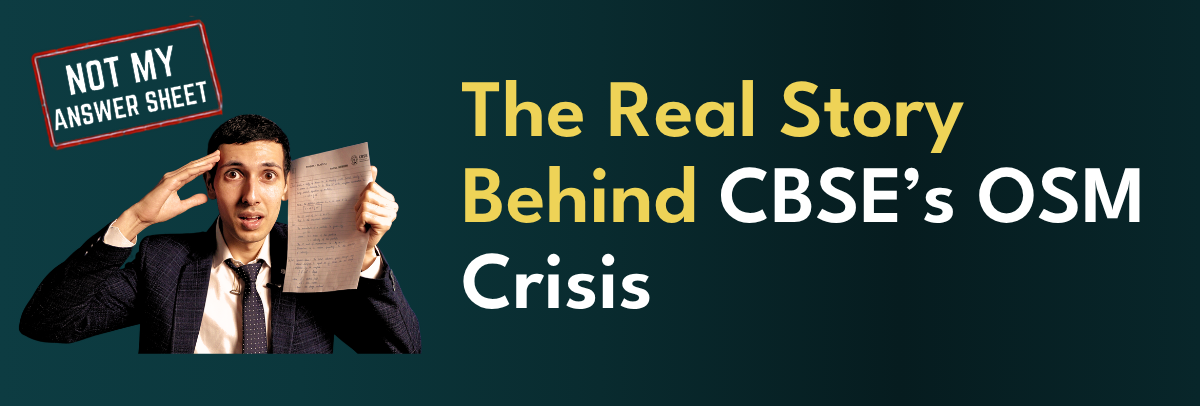
Soon after the 2026 CBSE Class 12 results, students began reporting problems with answer sheet copies, marks, scans, and the re-evaluation portal. Some alleged that pages were blurry. Others claimed that marks were missing or wrongly totalled. A few reported something even more alarming: answer sheets that did not seem to belong to them. What began as scattered social media posts soon became a full-blown trust crisis.
The real story is not simply that a digital system had glitches. It is that the CBSE OSM crisis exposed how fragile India’s exam infrastructure can feel when technology is rolled out faster than people are prepared for it.
CBSE OSM Crisis: What Exactly Happened?
OSM stands for On-Screen Marking. Instead of sending physical answer booklets to examiners, answer sheets are scanned, uploaded to a secure platform, anonymised, and evaluated digitally. On paper, this sounds efficient. It can reduce transport delays, make distribution faster, and create a clearer digital trail.
That is the promise. The problem is what happens when the promise meets the pressure of a nationwide board exam.
This year, CBSE implemented OSM at scale for Class 12 evaluations. Soon after CBSE declared the results, students applied for scanned copies and re-evaluation in unusually large numbers. Many did not just feel disappointed with their marks; they felt confused by what they saw in their answer sheets. Students and parents complained about faded scans, cropped pages, incorrect marking, missing totals, and portal-related issues. CBSE claimed that its systems were functioning properly, but the intensity of student complaints kept the controversy alive.
And that is where the CBSE OSM crisis became bigger than one student, one subject, or one bad scan. It became a question of accountability.
When a student’s answer sheet is blurred, the student is thinking: Was my work even seen clearly? When a portal fails during a narrow re-evaluation window, the student is thinking: Will I lose my only chance to challenge this?
That emotional reality matters.
Why the CBSE OSM Crisis Felt So Personal to Students
Board exams in India are not treated like ordinary tests. They are treated like milestones. Families plan around them. Students lose sleep over them. Teachers remind children for years that neat handwriting, step marking, diagrams, presentation, and final answers can decide their future.
So when the evaluation process itself comes under doubt, students feel betrayed.
What made the CBSE OSM crisis particularly painful was the mismatch between the standard expected from students and the standard apparently delivered by the system. A student can lose marks for skipping a step, misreading a question, or making a tiny calculation error. Yet when students questioned the evaluation process, the board offered few clear answers and expected them to trust the same system they were challenging.
Digital evaluation can be faster, cleaner, and more transparent when implemented well. But technology does not become trustworthy just because it is digital. It becomes trustworthy when it is tested carefully, explained clearly, and supported by people who know how to use it.
Before a system affects lakhs of students, a few questions should be non-negotiable:
- Were evaluators trained properly?
- Were scanning standards high enough for every subject?
- Were dry runs conducted at a meaningful scale?
- Was the re-evaluation portal ready for heavy traffic?
- Were students given a simple, fair way to report errors?
- Was there a backup plan for unreadable or mismatched answer sheets?
These are not technical luxuries. They are the basics of fairness.
The Bigger Problem Behind the CBSE OSM Crisis
The deeper concern is not that a new system faced problems. New systems often do. The concern is whether the rollout treated students like stakeholders or like test subjects.
Reports around the CBSE OSM crisis have raised questions about implementation timelines, vendor selection, scanning quality, portal performance, and the handling of student grievances. Public scrutiny also grew after students and independent voices began examining tender documents and asking why certain technical requirements appeared to have changed over time. When teenagers are asking sharp governance questions, the adults in charge should probably pause and listen.
There is also a communication problem. In moments like this, students do not need polished messaging. They need clarity. They need to know what went wrong, how many cases were affected, what correction process exists, and how quickly mistakes will be fixed. A defensive tone only deepens mistrust.
If a student submits an incomplete answer, they lose marks. If an institution rolls out an incomplete system, it should not get to hide behind vague reassurances. Accountability should travel upward as well.
What Students Can Learn from the CBSE OSM Crisis
Many of the loudest questions came from students who checked their documents, compared evidence, posted responsibly, and demanded answers.
That matters.
For students, the lesson is not to become cynical. It is to become informed. Keep records. Download documents. Read official notices carefully. Ask questions when something looks wrong. Speak up without spreading unverified claims. Most importantly, do not let one exam result define your entire academic story.
Marks matter, but they are not the whole picture. Colleges, scholarships, and future opportunities increasingly look for students who can think critically, communicate clearly, and respond to real-world problems with maturity. Ironically, the students who questioned the CBSE OSM crisis demonstrated exactly those qualities.
This is also a reminder for parents. Your child needs support before strategy. If their marks do not match expectations, help them review the answer sheet, understand the official process, and take the next step without panic. Re-evaluation can be important, but so is emotional steadiness.
For schools and policymakers, the message is clear: reform cannot be cosmetic. If India wants modern assessment, it must invest in training, infrastructure, transparency, and grievance redressal. Students deserve more than a system that asks for trust after something goes wrong; they deserve a system that earns trust before results are declared.
To understand the full story in more detail, watch our complete breakdown on our YouTube channel.
At Athena, we work with students who are navigating exactly this kind of uncertainty: board results, college planning, profile building, essays, and the pressure to turn ambition into direction. If the CBSE OSM crisis has left you wondering how to protect your academic journey and build a stronger future beyond one exam, book a free Athena consultation. Our mentors will help you understand your options, strengthen your profile, and plan your next step with confidence.
Also join our Discord community to meet other ambitious students, ask questions, exchange ideas, and stay motivated through the ups and downs of high school life.