


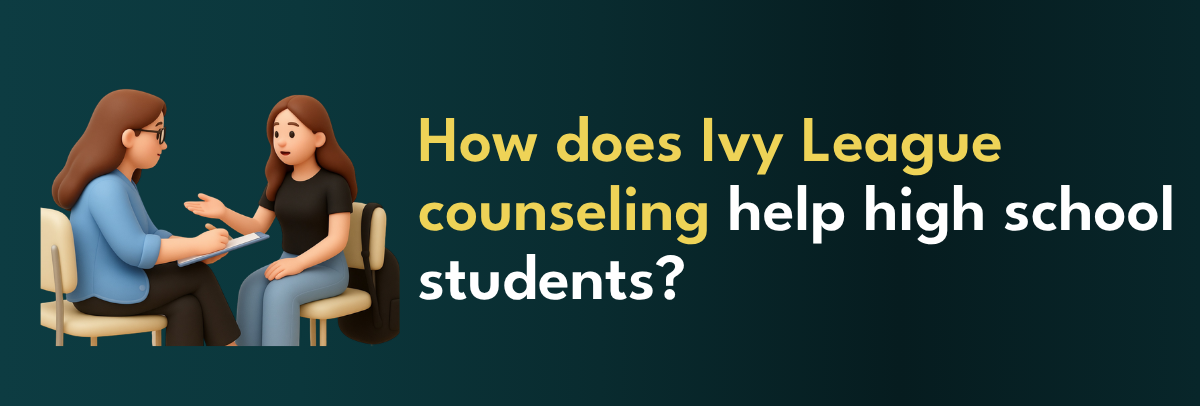
Ivy League counseling helps high school students make sense of a process that can otherwise feel vague, stressful, and full of half-answers. For example, a student may know they want to apply to Harvard, Yale, Princeton, Columbia, Brown, Dartmouth, Cornell, or Penn. But knowing the dream is not the same as knowing the path.
For most families, the confusion starts early. Should a student focus more on grades or extracurriculars? Is research necessary? Are internships useful? Which activities look strong? When should essays begin? Should the student take the SAT, ACT, APs, or something else? And how do they stand out when thousands of students are applying from around the world?
These are not small questions. Ivy League admissions are holistic, competitive, and deeply personal. There is no fixed formula that guarantees admission. This is why Ivy League counseling can be so valuable for high school students. It gives them structure, direction, and a much clearer understanding of what they are building toward.
Many students begin with a broad goal: “I want to study abroad” or “I want to get into an Ivy League university.” That ambition is important, but it needs direction. Without guidance, students often copy what others are doing. They join the same clubs, enter the same competitions, or chase activities they think will “look good.”
Ivy League counseling helps students understand who they are as learners and what kind of profile they should build. A counsellor may ask: Which subjects genuinely interest you? What problems do you keep thinking about? Where have you shown initiative? What kind of work makes you lose track of time? In the end, these questions matter because the strongest applications usually grow from real curiosity, not from a checklist.
Starting early also gives students time. Grades 9, 10 and 11 are not just years to collect achievements. They are years to explore, experiment, fail, improve, and grow. A student who begins early can build different interests before choosing where to go deeper. That is far more beneficial than trying to create an entire personality in the final months before deadlines.
Right guidance also reduces panic. Instead of wondering what to do every few weeks, students can follow a roadmap. They know when to focus on academics, when to explore activities, when to begin with their essays and when to finalise college lists.
Build a Stronger Profile
A strong college profile is not about doing everything. It is about doing the right things with depth, consistency, and purpose.
This is where many students misunderstand Ivy League admissions. They assume that more activities automatically mean a stronger profile. So they add MUN, coding, volunteering, internships, sports, music, research, Olympiads, and leadership roles, often without a clear connection between them.
Admissions officers are not simply counting activities. They are looking for patterns. They want to see what the student cares about and how they have acted on that interest over time.
Ivy League counseling helps students build that pattern. For example, a student interested in environmental science might combine coursework, independent reading, a local sustainability project, science competitions, and research. A student interested in economics might explore data analysis, internships, policy projects, and entrepreneurship. A student interested in literature might build through reading, writing, publishing, editing, teaching, or storytelling.
The point is not to become narrow. The point is to become memorable.
A useful way to think about profile building is “depth over scatter.”
Here are a few ways Ivy League counseling helps students build stronger profiles:
- Identify genuine academic and extracurricular interests
- Choose meaningful activities
- Build a clear “spike” or area of depth
- Track achievements, impact, and personal growth
- Find suitable summer programs, competitions, or projects
- Avoid overloading the student with unnecessary activities
- Connect experiences into a clear admissions story
More importantly, this matters because by the time applications begin, the student should not look like a list of disconnected achievements. They should look like a person with direction, curiosity, and potential.
Make Essays and Applications Easier
For many high school students, essays are the hardest part of the Ivy League application process. Not because they cannot write, but because personal writing is unfamiliar to them.
School essays often reward structure, information, and formal language. College essays ask for reflection. They ask students to write about who they are, how they think, what they value, and how they have changed. It can feel uncomfortable, especially for students who are used to proving themselves through marks and achievements.
This is where Ivy League counseling becomes especially useful.
The counsellor does not write the essay for the student. Instead, that would weaken the application. The goal is to help the student find their own voice and express it clearly. The best essays rarely sound like speeches or motivational posts. They sound specific, honest, and alive.
Sometimes the strongest essay comes from a small moment: a family conversation, a failed experiment, a book that changed the student’s thinking, a classroom question, a community problem, or a quiet moment of responsibility. The topic does not need to be dramatic. The reflection needs to be real.
Counseling also helps students understand the full application, not just the main essay. The activity list, honours section, recommendation strategy, supplemental essays, and additional information section – all matter. If these pieces repeat the same thing, the application feels flat. If they work together, they create a fuller picture.
High school students often underestimate how much time this takes. A strong essay may need several drafts. A short supplemental answer may take hours because every word has to earn its place. Ivy League counseling gives students a process: brainstorm, draft, revise, refine, and review without losing authenticity.
Ivy League Counseling Supports College Strategy
Several Ivy League universities have brought back SAT or ACT requirements after the pandemic-era test-optional period. Harvard announced that applicants for fall 2025 admission would again need standardized testing, with limited alternatives in exceptional cases. Princeton has announced that it will reinstate SAT or ACT requirements from the 2027–28 admissions cycle, while Yale follows a test-flexible approach and Columbia has remained test-optional in recent reporting.
For high school students, this means old advice can be risky. A student cannot simply assume that testing does not matter. However, they need to check each university’s latest policy, decide whether the SAT or ACT suits them better and plan testing early enough to avoid pressure in Grade 12.
Students also need to understand Early Decision, Early Action, Restrictive Early Action, and Regular Decision. They need to build a balanced college list. They need to know which university fits them. Applying to all eight Ivy League colleges just because they are famous is not a strategy. Each one has a different academic culture, campus environment, curriculum style, and student experience.
Ivy League counseling helps families make these decisions thoughtfully. It brings together ambition and realism, It helps students choose universities where they can genuinely thrive, not just names that sound impressive.
It also supports parents. The admissions process can become emotional very quickly. Families hear advice from relatives, school groups, online forums and other parents. Some of it may be useful. Much of it may not fit the student. A counsellor gives the family a steady point of reference, helping them make decisions calmly instead of reacting to every new opinion.
In the end, Ivy League counseling is not about shortcuts. It is about helping high school students grow with intention. It helps them understand their strengths, build a meaningful profile, write with honesty, and make smarter choices about testing, timelines, and universities.
For a high school student, that is a powerful advantage.
If your child is dreaming of top US universities and you want to plan the journey with more clarity, book a free Athena consultation today. Athena’s mentors can help your family understand where their child stands, what they should build next, and how Ivy League counseling can support a stronger path forward.