


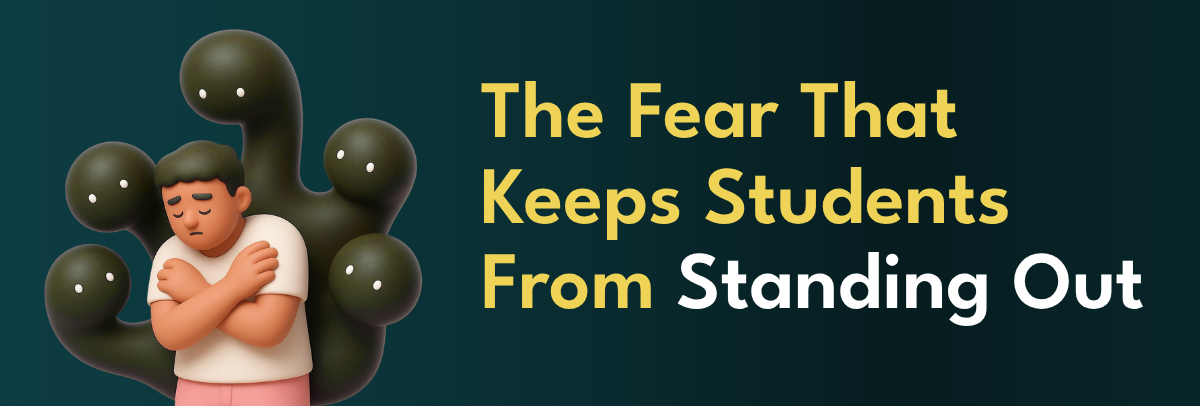
Student fear is one of the quietest reasons brilliant teenagers stay invisible. Not lack of talent. Not lack of ambition. Not even lack of opportunity. Very often, the real reason is simpler and more painful: What will people think?
A student has an unusual essay idea, then chooses the safer one. Another wants to start a podcast, but worries classmates will laugh. Someone else dreams of applying to a prestigious university, but quietly removes it from the list because rejection feels public, even when it isn’t.
This fear can look like laziness from the outside. It is not. It is ancient survival software running inside a modern student’s brain.
For most of human history, being accepted by a group was not a bonus. It was survival. A lone human in the wild was vulnerable. A human inside a tribe had food, protection, warmth, and belonging. So the brain learned a brutal rule: don’t get rejected by the group.
That rule helped our ancestors stay alive. Today, it often stops students from building the kind of distinctive profile that colleges, scholarships, mentors, and future employers actually remember.
Why Student Fear Feels So Powerful
To understand student fear, we need to stop treating it like a personality flaw.
For roughly 300,000 years, humans survived by coordinating in groups. We were not the strongest animals. We were not the fastest. We had no claws, no fangs, no natural armor. Our advantage was cooperation. We watched each other’s backs. We shared information. We built tools. We survived because we belonged.
That history did not disappear just because students now live in apartments, attend school, and submit applications online. The brain still treats social risk like physical danger.
That is why raising your hand in class can feel strangely terrifying. That is why sharing a college essay can feel more vulnerable than taking a test. That is why posting an original opinion online can make a student’s heart race.
This is the strange truth: student fear often has very little to do with the actual task. The task may be small, like sending an email, asking a question, publishing a post, or trying out for a competition. But the brain interprets it as a social trial.
What if I look stupid?
What if people judge me?
What if I fail and everyone knows?
What if I succeed and people think I am showing off?
That last one is especially common. Many students are not only afraid of failure. They are afraid of being visibly ambitious.
The Modern Tribe: School, Social Media, and “Log Kya Kahenge”
Every generation has had a tribe. Today’s students have several.
There is the school tribe. The tuition class tribe. The WhatsApp group tribe. The Instagram tribe. The extended family tribe. The parent-friend comparison tribe. Each one carries its own invisible rules.
Don’t be too loud.
Don’t be too different.
Don’t try too hard.
Don’t fail publicly.
Don’t make people talk.
In South Asian households, this pressure often arrives in three famous words: Log kya kahenge? What will people say?
It sounds like a small phrase, but it’s not.
A student may avoid theatre because relatives will call it “timepass.” Another may not discuss their interest in philosophy, gaming, design, public policy, or stand-up comedy because it does not sound “serious” enough. Someone may hide a passion project because their friends are only talking about marks, coaching, and rank.
This is how student fear becomes expensive. It does not always destroy a dream dramatically. Sometimes it simply edits it down, one small compromise at a time.
The irony is that young people are growing up in a world where distinctiveness matters more than ever. For the first time in human history, average is being automated. AI is the world’s most capable average performer. It writes adequate essays, draws adequate pictures, codes adequate software, summarizes adequate research. Adequate is what AI does.
What cannot be mass-produced is a student’s original way of seeing the world.
How Student Fear Hurts College Applications
College admissions is not only a contest of grades. At selective universities, many applicants already have strong scores, rigorous subjects, and polished resumes. The question becomes: who feels alive on the page?
Admissions officers remember students who have a point of view. They remember students who have followed curiosity beyond the classroom. They remember essays that sound specific, honest, and lived-in.
But fear pushes students toward sameness.
It tells them to choose the essay topic that sounds “impressive,” not the one that is true. It tells them to join the same clubs everyone else has joined. It tells them to describe leadership in the safest possible language. It tells them to sand down the weird edges.
This is where the fear of standing out becomes a real admissions disadvantage. A student who has done meaningful work may still present it timidly. A student with an unusual story may bury it under clichés. A student with a bold idea may never build the project because they are waiting to feel fully confident first.
Confidence rarely arrives first. Action usually does.
There is a reason exposure works. The brain learns through evidence. If a student speaks once and survives, the alarm reduces slightly. If they share a draft and receive useful feedback, the alarm reduces again.
The goal is not to become fearless. Fearless people are rare, and often reckless. The goal is to become practiced.
A student who practices visibility gets better at it.
How to Stand Out Without Panicking
The answer to student fear is not a motivational quote – “Believe in yourself” is nice, but it is not a strategy.
A better strategy is controlled exposure: small, repeated acts of courage that teach the brain, “I can handle this.”
Students do not need to begin with the scariest thing. In fact, they should not.
Here are three moves to begin with:
- Make a fear inventory. Sit down this week. Write down five things you’ve been avoiding because of social fear. Rank them, least scary to most. Take the smallest one. Just one.
- Build an exposure ladder. Pick one fear – public speaking, posting online, cold emails, conversations with strangers and do a slightly harder version each week for the next three months. The brain updates faster than you think.
- Use AI as your sparring partner. Once a week, open an AI chatbot and ask it to roast your argument, your essay, your idea, your plan. Tell it to push you. Stay in the conversation until it can’t find another hole. You’re not preparing for a test. You’re inoculating your nervous system.
At Athena, we help students find the ideas, stories, projects, and ambitions that make them unmistakably themselves. If your child is holding back, we can help them turn hesitation into direction and direction into a powerful college admissions profile.
Book a free Athena consultation to discover how your child can start with confidence, clarity, and courage.