


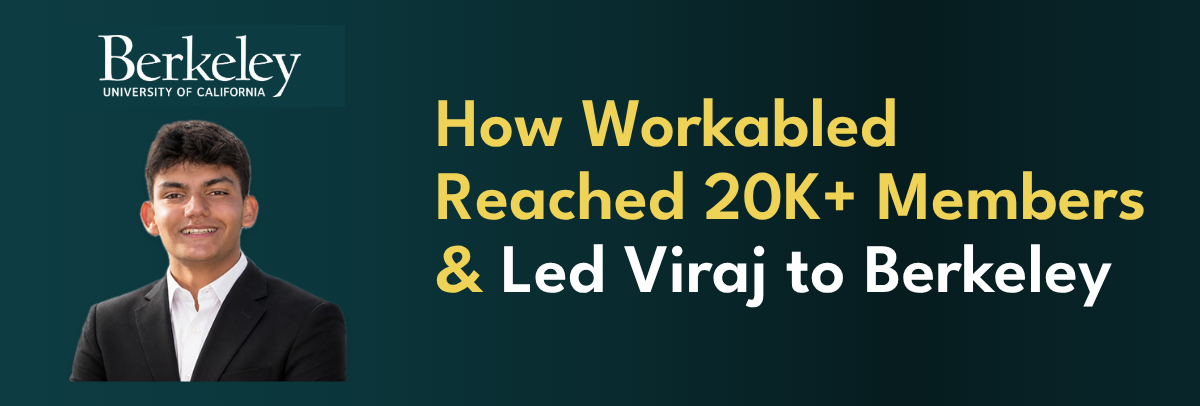
Workabled began with a problem that is much bigger than college admissions: people with disabilities often face serious barriers when trying to find employment.
Viraj Gupta decided to do something about it.
He built Workabled, a platform designed to connect people with disabilities with inclusive employers. The initiative went on to onboard 20K+ members and collaborate with Samarthanam, an NGO working in the disability inclusion space. Workabled is one of several student-led initiatives featured in Athena Education’s Class of 2026 Annual Results Report, where the project’s 20K+ member milestone and Viraj’s UC Berkeley outcome are highlighted.
The interesting part is not just the 20K+ figure.
It is the problem he chose to work on in the first place.
How Workabled Started With a Real Employment Problem
A lot of student projects start with the question: What will look impressive on my college application?
Workabled starts from a much stronger question:
Who is being left out, and why?
People with disabilities continue to face major disadvantages in the labour market. The International Labour Organization reported in 2025 that labour-force participation among persons with disabilities is 30% lower than among people without disabilities. Young people with disabilities are also twice as likely to be neither in employment, education nor training.
That gives Workabled a very real context.
The project was not solving an invented student problem. It addressed an existing employment gap.
Athena’s article on turning a hobby into a college admissions asset makes a related point: meaningful extracurriculars become stronger when students move beyond simply participating and start building, solving or contributing.
How Workabled Reached 20K+ Members
The number that immediately stands out in Workabled’s story is 20K+ members onboarded.
Why does that matter?
Because building a website is one thing.
Convincing thousands of people to join or engage with what you have built is another.
Workabled moved beyond being a concept and developed a real user base. That gives the project a layer of validation that a simple “Founder” title cannot provide.
The progression is useful for any high-school student thinking about a passion project:
- Start with a problem you genuinely understand.
- Build something that addresses it.
- Put it in front of real users.
- Work with organisations already active in the space.
- Measure whether the project is actually reaching people.
That last point is especially important.
Numbers should not exist simply to make an application sound impressive. They should show that the project left the student’s immediate circle and reached the people it was designed for.
If you already have an idea but are unsure how to turn it into a credible project, you can book a free Athena consultation. Athena’s admissions process includes profile development and personalised roadmaps built around a student’s academic and extracurricular interests.
Why Workabled Strengthened Viraj’s Berkeley Profile
It would be misleading to say that Workabled alone got Viraj into Berkeley.
No single extracurricular does that.
However, Workabled gave his application something valuable: a project with scale, purpose and ownership.
Viraj did not simply volunteer for an organisation working in disability inclusion. He helped build a platform around the problem.
Moreover, his profile shows a broader academic interest in technology. He identifies himself as an incoming student at UC Berkeley’s College of Computing, Data Science, and Society and lists interests in computer science, software engineering and AI.
That creates a much stronger narrative than a random collection of activities.
Technology becomes connected to a real social problem.
Athena’s guide to what admissions officers actually read first explains why this kind of coherence matters. Admissions readers are trying to understand what a student cares about, how their interests connect and what differentiates them from other academically strong applicants.
Workabled has clear evidence behind it:
20K+ members. A defined problem. An NGO collaboration. A real audience.
That is much more compelling than an impressive-sounding title with nothing underneath it.
What Students Can Learn From Workabled
The lesson from Workabled is not that every student should start a disability employment platform.
It is that strong projects usually begin by paying attention.
Maybe there is a problem in your school nobody has fixed, maybe your city has an accessibility issue people overlook, or maybe you are interested in coding and can build something useful for a community that existing technology does not serve well.
The idea does not need to sound extraordinary at first.
It needs to matter enough that you are willing to keep working on it.
That is also why starting early makes such a difference. Athena’s guide on building a college profile from Grade 10 recommends using those earlier years to explore interests, develop experiences and gradually build depth rather than rushing to assemble activities close to application season.
Workabled eventually reached 20K+ members and collaborated with Samarthanam.
Those are impressive outcomes.
But the more useful takeaway is what came before them. Viraj found a real problem, built around it and created something people actually joined.
That is what makes the project memorable.
If you are trying to figure out how your own interests could become a meaningful project, book a complimentary consultation with Athena to start mapping out a path that actually fits you.
For more project ideas, opportunities and conversations with students building things of their own, you can also join the Athena Discord community.