


Some of the best college projects begin with something surprisingly simple: a student cares deeply about something and decides to take it further.
For Alvira Tripathi, that interest was the mountains.
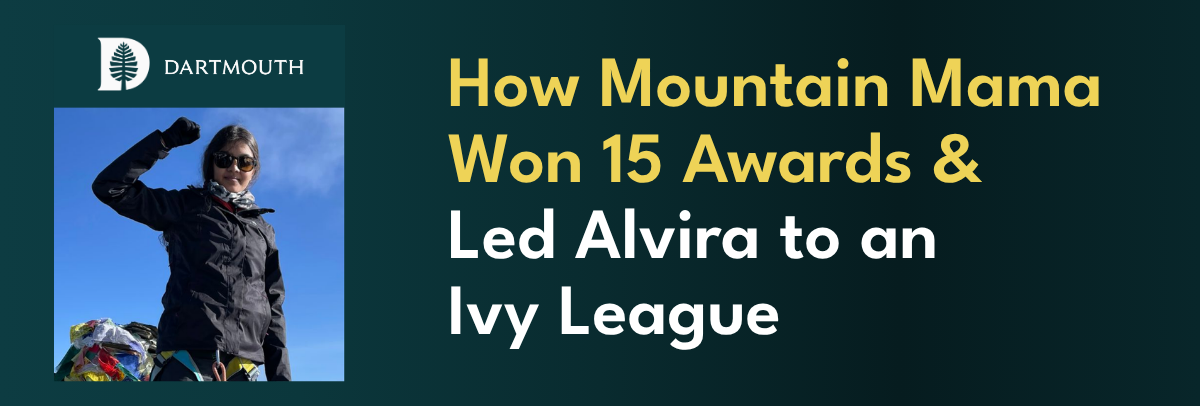
It eventually became Mountain Mama, a youth-led platform centred on mountains and trekking adventures. The project grew to cover 25+ routes, generate 80K+ impressions and win 15 international awards. Alvira later earned admission to Dartmouth College, an Ivy League university.
Mountain Mama is also one of the student projects featured in Athena Education’s Class of 2026 Annual Results Report, which showcases the projects, stories and outcomes behind this year’s student cohort.
The interesting part, though, is not simply the number of awards.
It is how one genuine interest became something distinctive enough to tell you immediately who Alvira was.
How Mountain Mama Grew From an Interest Into a Real Project
Students often hear that they need a “passion project” for college admissions and immediately begin searching for something that sounds impressive.
That is usually the wrong starting point.
Mountain Mama worked because the subject itself was personal. Instead of creating an activity solely for an application, Alvira developed an existing interest into something with greater depth and reach.
The platform eventually documented more than 25 trekking routes and reached 80K+ impressions.
That progression matters.
A hobby becomes a meaningful project when you begin doing something with it: researching, documenting, building, teaching, testing or creating something other people can use.
This is the same principle behind turning a hobby into a college admissions asset. The strongest extracurriculars are rarely the ones students choose because they sound prestigious. They are the ones students care enough about to keep developing.
Mountain Mama is a good example of that.
How Mountain Mama Won 15 International Awards
Awards did not make Mountain Mama interesting.
They validated work that was already interesting.
As the project grew, it earned 15 international awards, an unusually strong level of external recognition for a high-school project.
That distinction is important.
Students sometimes approach competitions backwards. They find an award first and then create something purely to enter it.
A stronger sequence is:
Build something meaningful → improve it → put it in front of credible judges or audiences.
External validation then becomes evidence that the work has quality beyond the student’s own description.
Athena’s guide on how competitions strengthen college applications explains why this matters. Awards are most useful when they strengthen an existing area of interest rather than becoming another disconnected certificate.
Mountain Mama therefore gave Alvira several things at once: a sustained project, measurable reach, a clear personal interest and credible recognition.
If you are trying to figure out what that kind of project could look like for your own profile, you can book a free consultation to explore ideas based on your interests rather than forcing yourself into a generic extracurricular template.
Why Mountain Mama Strengthened Alvira’s Ivy League Profile
It is tempting to say, “Mountain Mama got Alvira into Dartmouth.”
College admissions is not that simple.
No single project guarantees admission to an Ivy League university. Strong academics, essays, recommendations, extracurriculars and the overall story of the applicant all matter.
What Mountain Mama did give Alvira was something many applications struggle to create: identity.
An admissions officer reading hundreds of strong applications needs to understand what makes one student different from another.
Mountain Mama gave them something concrete.
It demonstrated initiative because Alvira built beyond an existing interest. It demonstrated depth because the project grew over time. It showed external validation through 15 international awards and audience interest through more than 80K impressions.
Most importantly, it felt connected to the student behind it.
Athena’s Annual Report makes this broader point about the 2026 admissions cycle: successful profiles increasingly showed authenticity, ownership and real evidence behind what students claimed to have done.
That is also why understanding what admissions officers actually read first matters. Strong applications do not simply contain impressive activities. Their activities help create a coherent picture of the student.
What Students Can Learn From Mountain Mama
The lesson is not that every student should build a website, become a trekker or win 15 awards.
The lesson is much more useful:
- Start with something you actually care about and ask how far you can take it.
- A photography hobby might become a visual archive of disappearing neighbourhoods.
- An obsession with Formula 1 might become a data project analysing race strategy.
- An interest in wildlife might become a local biodiversity initiative.
The idea does not need to sound extraordinary on day one.
What matters is what happens afterwards.
Students who begin earlier naturally have more time to experiment, fail and improve. Athena’s guide on building a college profile from Grade 10 shows how those early interests can gradually turn into deeper projects rather than last-minute résumé additions.
Mountain Mama eventually reached 25+ routes, 80K+ impressions and 15 international awards.
Those results are impressive.
But the better takeaway from Alvira’s journey is that she did not need fifteen unrelated extracurriculars to stand out.
She had something that was recognisably hers.
And that is often far more memorable.
You can see Mountain Mama alongside other standout student projects and admissions outcomes in Athena’s Class of 2026 Annual Results Report.