


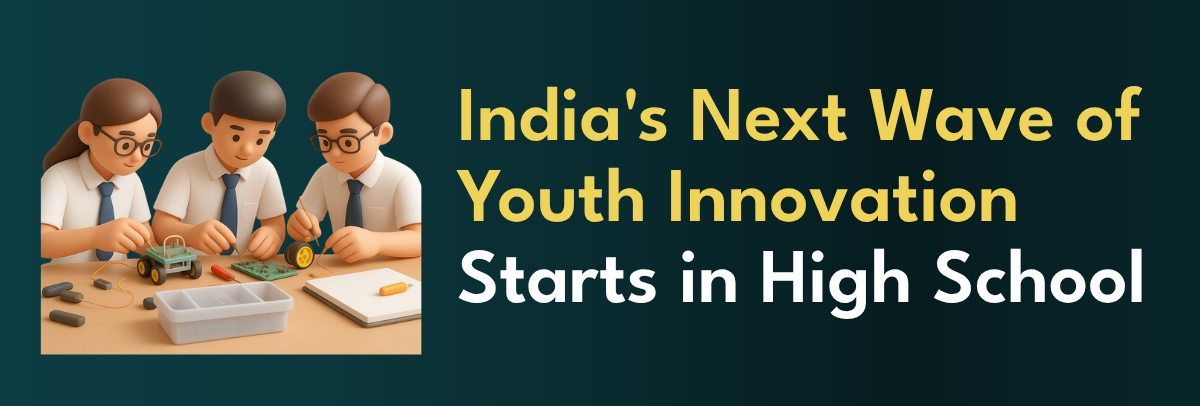
Youth innovation in India is not waiting for students to graduate from college, join a startup or enter a corporate boardroom. It is already taking shape in classrooms, neighbourhood markets, family businesses and communities that young people observe every day.
A teenager notices that a local shopkeeper manages orders through WhatsApp. Another sees that people in a village depend on a neighbour’s QR code to make digital payments. Someone else begins wondering whether social media has quietly become the first storefront for a new generation of entrepreneurs.
These observations may look ordinary at first. Yet they often contain the beginnings of an important question, a research project or even a practical solution.
That was the thinking behind the Digital Desh Challenge, organised by Athena Education in partnership with Digital Desh. On 25 July 2026, shortlisted students arrived at Athena’s Gurugram office to present ideas inspired by the changing digital realities of India.
However, this was not simply a competition about who could make the most polished presentation. It was an opportunity for students to look around them more carefully and ask: What is changing, who is being left behind and what could we build next?
Youth Innovation Begins With Looking More Closely
Young people are often told that innovation begins with a revolutionary idea. In reality, it usually begins with attention.
A student does not need to invent the next global technology company to demonstrate original thinking. Sometimes, the more valuable skill is noticing a behaviour that adults have begun taking for granted.
How are local businesses using Instagram to find customers? Why do some families own smartphones but still rely on others to complete online payments? How are students in smaller towns accessing online education? What happens when technology is available, but confidence, language or reliable internet access is not?
Digital Desh has spent more than a decade studying India’s digitisation through on-the-ground research. Its approach looks not only at habits that have already become widespread, such as UPI, WhatsApp and online video, but also at unusual behaviours developed by individuals working around local constraints. These outliers can reveal what wider digital adoption may eventually look like.
That approach matters for students because it turns the world around them into a research environment.
Rather than beginning with a vague topic such as “technology in India,” they can begin with a specific person, transaction, difficulty or behaviour. From there, they can collect evidence, test assumptions and develop a solution grounded in reality.
This is where meaningful youth innovation starts: not with trying to sound impressive, but with learning to see what others overlook.
Inside Athena’s Digital Desh Challenge
The Digital Desh Challenge was designed as a research and digital innovation challenge for high school students interested in startups, marketing, consumer behaviour, emerging markets, business strategy and technology.
Those selected for the final stage presented their ideas, moving beyond abstract ideas to explain the problem, target audience, consumer insight, positioning and proposed direction of their solution.
Students pitched their ideas directly to Athena’s co-founder and the founder of Digital Desh. For many high school students, this was a very different experience from answering a question in an examination.
Students explained why the problem deserves attention, whether their proposed solution could work and what evidence supports their conclusions.
That process builds several abilities at once:
- Conducting primary and secondary research
- Identifying meaningful consumer or community problems
- Turning observations into clear arguments
- Developing practical business and technology solutions
- Presenting confidently to founders and industry leaders
- Responding thoughtfully to questions and criticism
These are not skills reserved for future entrepreneurs. They are useful for anyone who will eventually work in research, public policy, engineering, design, economics, healthcare or social impact.
More importantly, students begin to understand that their age does not prevent them from contributing to serious conversations.
Why High School Innovation Matters Beyond Admissions
It would be easy to view a challenge like this only as a profile-building opportunity.
Certainly, original projects can strengthen a college application. They can demonstrate intellectual curiosity, initiative, communication and an ability to connect academic interests with real-world problems. Athena’s own approach to student development places significant emphasis on rigorous research, experiential learning and technically meaningful projects rather than superficial résumé additions.
Still, the value of high school innovation goes much further.
A student who conducts field research learns that people do not always behave the way a survey predicts. A student who proposes a digital product discovers that affordability, trust, language and access may matter just as much as technical sophistication. Or a student who pitches an idea learns that enthusiasm cannot replace evidence.
These lessons create a more mature form of confidence.
It is not the confidence of believing every first idea is brilliant. Instead, it is the confidence to investigate, revise and keep working when the initial answer proves incomplete.
That distinction matters because impactful projects rarely emerge fully formed. They develop through uncomfortable questions:
- Does the intended user genuinely need this?
- Who might be excluded?
- What would implementation cost?
- Could the solution work without uninterrupted internet access?
- Is technology solving the problem, or merely making the proposal sound more advanced?
When students learn to face thse questions early, they stop treating innovation as a performance. They begin treating it as a responsibility.
Building the Next Generation of Young Innovators
India’s next generation of builders will not come only from the largest cities, the most prestigious schools or students who already know how to code.
They may come from a student studying in Noida, a Grade 12 student in Jehanabad or a family conversation about why a digital service works well for one person and poorly for another.
What these students need is not permission to be curious. These students need room where that curiosity can be tested seriously.
They need mentors who will ask harder questions rather than immediately praising every idea. They need opportunities to conduct research, speak with real users, build prototypes, receive criticism and present their work to people outside school, they also need peers who are willing to exchange ideas rather than compete only for marks.
That is why initiatives such as the Digital Desh Challenge matter. They show students that academic knowledge does not have to remain inside a classroom. Economics can help them understand a neighbourhood market. Computer science can support rural healthcare. Sociology can explain why communities trust particular systems.
Most importantly, youth innovation does not require students to wait until they feel completely prepared. Research rarely begins with certainty. It begins with a question worth pursuing.
The next important idea may already be hidden in a student’s daily commute, a shop near their home or a difficulty their community has quietly learned to live with.
The first step is simply to notice it.
At Athena Education, we help students turn genuine interests into rigorous research, meaningful projects and distinctive academic journeys. Families looking for personalised guidance can book a free consultation with Athena’s experts to explore how a student’s curiosity can grow into sustained, real-world work.
Students can also join the Discord community to exchange ideas with ambitious peers, discover upcoming challenges and workshops, find collaborators and continue conversations that do not have to end when the event does.