


High school research is not reserved for students in white lab coats, university labs, or prestigious journals. It begins much earlier, usually with a question that refuses to leave you alone. Why does this happen? What if we tried it differently? Why has nobody solved this yet? At its core, research is curiosity with structure. For high school students, that structure turns a passing thought into a serious academic project.
The best student researchers are the ones who ask better questions, read what others have discovered, test their assumptions, and document the messy middle. Failed methods, confusing papers, dead ends, and revised hypotheses are not distractions from research. They are research.
That is why the 5-pillar framework matters. It helps students stress-test an idea before spending months on it. The goal is not to score perfectly on every pillar. The goal is to see where your idea is strong, where it is weak, and how to make it sharper.
Why High School Research Starts With a Better Question
Every meaningful project begins with a spark, but not every spark becomes research. A broad interest like artificial intelligence, climate change, or mental health is only a starting point. High school research becomes powerful when a student moves from “I like this topic” to “Here is a specific gap I want to explore.”
That shift usually happens through reading. Before committing to a topic, read at least five papers, reports, or articles. You do not need to understand every sentence. Even understanding 40% of each paper is enough at first. With every paper, you start noticing patterns: what researchers agree on, what they ignore, what they measure, and what they still cannot explain.
This is where originality begins. It may mean asking an old question with a new dataset, applying a method from one discipline to another, studying an overlooked population or testing an assumption everyone repeats but few people examine closely.
A good question should feel narrow enough to investigate and important enough to matter. “Can AI help education?” is too broad. “How do AI study tools affect revision habits among Indian high school students preparing for board exams?” is more researchable because it has context and direction.
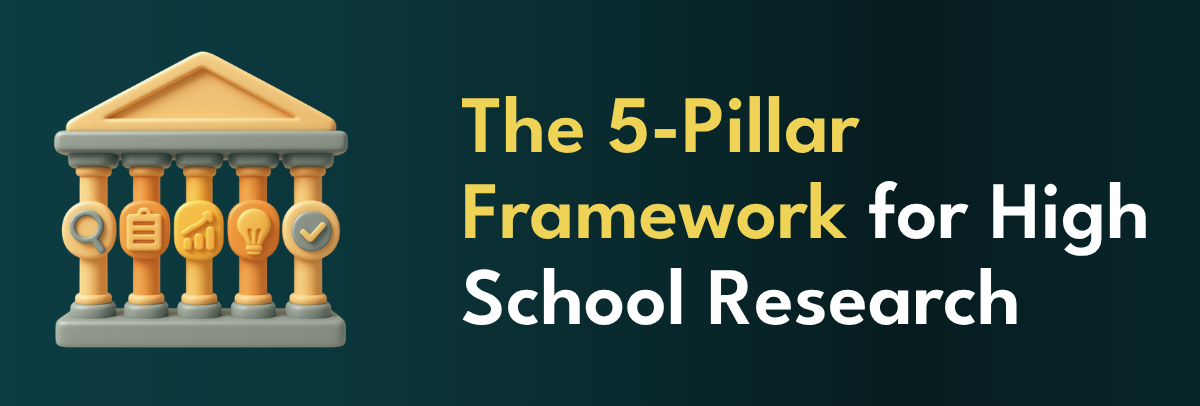
The 5-Pillar Framework for High School Research Ideas
Once you have a question, test its strength. The 5-pillar framework helps you look at your idea honestly before you commit weeks or months to it.
- Rigor: Is your method sound, your evidence reliable, and your logic clear? External value: Would someone outside your classroom care about the answer? Originality: What exists in your work that did not exist before? Staying power: Will this question still matter after the current trend fades? Real impact: Could your findings influence a policy, product, practice, discussion, or future study?
Rigor is the backbone. A project becomes convincing when the method fits the question and the evidence is handled carefully. If you are using a survey, your questions must be fair and specific. If you are analyzing data, your sources must be credible. If you are reviewing literature, your argument must show that you have understood the field, not cherry-picked convenient quotes. - External value asks a tougher question: who benefits from knowing this? The answer does not have to be “the whole world.” It could be a school, a local community, a group of students, or future researchers. What matters is that the work reaches beyond an assignment.
- Originality is often misunderstood. You do not need a Nobel Prize-level idea. You need a fresh contribution. Maybe your method is original. Maybe your comparison is new. Maybe your perspective connects economics and psychology, biology and ethics, or literature and technology. Strong high school research often lives at these intersections.
- Staying power protects you from chasing hype. Some topics are trendy for three months and empty after that. Others keep becoming more relevant because they touch deeper questions about how people live, learn, build, govern or heal. Real impact is the final test: can your work travel beyond a document?
How Strong Research Moves From Curiosity to Impact
The research loop is simple to describe and difficult to live through. You ask a question, read what exists, find a gap, choose a method, test your idea, fail in small ways, revise, and keep going. The final paper is only the visible part. The real work is in the notes, drafts, calculations, interviews, code, and decisions that came before it.
A negative result is still a result. If you tried five methods and none of them worked, that does not automatically make the project useless. If you can explain why they failed and what future researchers should avoid, you have still developed knowledge. Knowing what does not work can be as valuable as knowing what does.
History proves how small questions can grow. Mendel’s curiosity about inherited traits eventually helped reshape biology and medicine. Early questions about whether machines could learn helped create modern AI. The point is simple: today’s research can become tomorrow’s field, product, policy, or movement.
Building a High School Research Toolkit That Actually Works
Good research does not require perfect conditions. You do not need expensive equipment, a famous supervisor, or a university ID to begin. You do need discipline, intellectual honesty, and the right toolkit.
Start with Google Scholar when exploring a topic. It helps you see major papers, citation trails, and recurring authors. For computer science, mathematics, physics, and AI, arXiv is useful because it carries early-stage work that may not yet be in journals. Semantic Scholar can show which papers are connected. PubMed Central is valuable for biology and medicine, while JSTOR is useful for humanities and social sciences.
AI can support this process, but it should never replace your thinking. Use it to simplify a confusing paper, brainstorm methods, organize notes, or debug code. Do not use it to write your paper, generate citations, invent an experiment you do not understand, or skip the reading. Reviewers can usually tell when a student has outsourced the thinking. More importantly, the student learns very little.
The strongest projects often grow through collaboration. A teacher, mentor, professor, senior student, or research partner can help you see blind spots and sharpen your method. But your contribution must remain clear. If you work with others, document exactly what you did and how your thinking changed.
High school research teaches something AI cannot easily replace: judgment. You learn to ask better questions, weigh evidence, be incorrect gracefully, and notice gaps others miss. These skills matter far beyond college admissions.
At Athena, we help students turn curiosity into credible research, stronger profiles, and more thoughtful college applications. If you want to explore what high school research could look like for you, book a free Athena consultation today. And if you want to keep learning with other ambitious students, join our Discord community, ask questions, share ideas, and build your research journey with people who are just as curious as you are.